LightBlog

Most people don't know enough about money. A recent PhD told me his story: "Daniel, I'm 30 and I've been going to sch...

Image result for 5 things I've realized people don't know about money
Most people don't know enough about money.
A recent PhD told me his story: "Daniel, I'm 30 and I've been going to school for 25 years total. I never learned about money until I had to pay my debt. With my combined college and credit card debts, I'm paying a little over $2,000 per month. I thought my college degree would get me out of the rat race. Sure, I have a $100,000 per year job, but how can I ever have financial freedom?"
Imagine that: A PhD cannot enjoy his money until he pays his debts off by age 35! Most of the time, we never really learn any practical tips about money from society. Our parents, teachers, and bosses have failed to teach us these basic precepts that we need to live a successful life. We end up getting stuck with our money, guessing our way through our financial debacles.
On television, the pundits show the stock markets. They float around unfamiliar terms that the majority of people would never bother understanding. Other times, we hear about retirement plans, which means nothing to the average millennial. Becoming rich seems to be an impossibility because there are no practical teachings in our educational systems.
What must we do is understand how our personal finances really work? We cannot do it by evading the entire topic. Obviously, there's a deep need for educational reform in this area. If you're looking to learn more about personal finances, here are the five secrets most people don't know about money:
snow winter parent blizzard
Sean Gallup / Staff / Getty Images

1. Parents teach money values

Most of our financial behaviors start with our parents. Several months ago, I was shopping for a laptop. My father's voice came into my head: "Son, don't get the warranty. It's a waste of money since you won't need it. They're just trying to up-sell you." Of course, I didn't get the warranty because I believed my dad's voice.
Almost every material possession that you buy tends to go through the "parent's approval" process. Most people do not purchase certain goods and services simply because they know their parents would never approve of it. However, this way of thinking can often become detrimental if it stops you from learning the truth about money.
Most of our parents have taught us to "play it safe." They tell us to go to school and get a job. First-generation children have an extremely hard time with their parents because of this. I personally receive many letters from young adults who claim that their parents would throw a dysfunctional fit if they didn't receive their college degree. All of this results in a false obligation to please their parents.

2. College isn't the answer

The average college student graduates at 22, but works to pay off college loan at nearly $300 per month for approximately 20 years. As they approach their debt-free days, usually in their 40s, their desires for the "good life" has become so strong that they usually squander the extra money they have by indulging on extra expenditures for themselves and their families.
By the time they reach their mid-40s, they fall into a mid-life crisis. At this point, they've realized that all they've worked for is money. Yes, while some people attend school to gain knowledge and credentials, some simply go because of the "love of money." Because of this, some of them fall into a nervous breakdown, which may either lead to constructive or destructive behaviors.
Either way, college isn't the answer to financial freedom. It usually leaves you poor. Most people end up learning irrelevant information and unusable skills. You're better off reading dozens of books, attending conferences, and hiring a life or business coach, which would cost you a fraction of the amount of school. Plus, you'll learn far more about money by owning your education.

3. Get rid of the 'someday mentality'

Many people have the "Someday Mentality." This is when they see a nice home and they say, "Someday, I'll be able to afford that home." With this mindset, you've separated yourself emotionally from owning that home, which means that you have assumed that your self-esteem is not there yet.
Instead, you should say, "That home is mine right now and I'll do whatever it takes to get it." This attitude reflects your belief that the house (or one like it) is yours for the taking. Once affirmed in your mind, all of your actions will lead you obtaining your desire, if wished upon strongly enough.
Moreover, many people wait for external circumstances to occur before they take action: tax checks, children's graduations, end of car payments, etc. This habit of waiting for "someday" limits you substantially and keeps you from the ultimate good that has your name written all over it. Assume that you have all things now and you'll have it sooner than you think!

wealthy outdoor dinner night
Eugene Gologursky / Stringer / Getty Images

4. Wealth is a choice

It's your choice to be wealthy. No one can make that choice for you. However, most people have never made this decision — simply because they don't know that they can. The easiest way to decide is to accept that you want a certain lifestyle. Once you do that, you must develop goals, which should also outline a plan-of-action for its attainment.
Often, people cannot make a choice about wealth because they are caught up in their addictive behaviors. They end up wasting time and money by excessively pursuing unworthy endeavors: drugs, sex, gambling, oversleeping, entertainment, and other deleterious behaviors. These addictions cloud your mind and prohibit clear thinking.
The choice of wealth cannot be avoided. Those who do not make the choice will be confused for the rest of their lives. Unfortunately, most people have taken the vow of poverty (unknowingly), but they've still made the choice. By making a choice of wealth, you'll only pursue wealthy and profitable activities, thereby reducing and eliminating unprofitable ones.

5. Avoid erroneous thinkers

Many people have erroneous beliefs about money. There are many false teachers who have taught that having money is not good, leaving many people to feel guilty about becoming wealthy. These instigators jump to conclusions and assume that nearly ALL rich people are bad.
When they see people with money, they say that something must be "lacking" in their lives, since having so much money seems too good to be true. However, you should never be discouraged by having money. Money is good and anyone telling you that you shouldn't have it probably doesn't have it themselves.
Many times, you can end up doing more good for society by having it, also making more friends in the process. Money allows you to become more of who you are, fulfilling your life's purpose. Instead of conforming to the habits, behaviors, and philosophies of other people, seek a new direction by befriending those who understand what wealth is all about.
As you pursue a prosperous life, learn about your attitudes and behaviors regarding money. Oftentimes, you'll be able to catch yourself and make the necessary adjustments. Eventually, you'll become wealthier because you've studied and applied the truths to enhance your relationship with money. When you do, send me a note. I'd love to hear your story.
Read the original article on Entrepreneur. Copyright 2016. Follow Entrepreneur on Twitter.

What a long, strange couple of months it's been for me. On the blog, things have been quiet. Behind the scenes, I've been as busy ...

Image result for Five short anecdotes about money
What a long, strange couple of months it's been for me. On the blog, things have been quiet. Behind the scenes, I've been as busy as I've ever been.
The good news is that this busy-ness will (eventually) lead to a number of interesting articles. I've been reading Cal Newport's Deep Work, for instance, and have some thoughts on it. I've been thinking about the concept of “no speed limits”. Shocking but true: I'm going to write an article about my primary credit card. And I've been reading and writing a lot about “doing nothing”.
Today, though, I want to clear my head (and my inbox) by sharing five short financial anecdotes.
In the past month, I've had probably twenty deep discussions about personal finance and personal values. While some of these conversations lead to bigger things (like the three articles I mentioned above), most don't. But they still produce intertesting concepts and ideas. They sometimes lead me to make changes.
Here are a five money-related topics that don't (yet) warrant articles of their own, but which I still find interesting (and worth sharing).

Going with Google

During my ten days in Portugal for the FI chautauqua, cell phone service was a common topic of conversation. Some folks didn't have any. Others were paying a small fortune just to get a tiny bit of data from their provider.
There were two types of people who didn't have any trouble with their cell service in Portugal: those who use T-Mobile and those who use Google FI.
“What's Google FI?” I asked. I'd never heard of it.
“It's Google's cell service,” Owen said. “It's cheap and has lots of features, but you can't use it with Apple phones.”
“Actually, you can,” Bill said.
“But the website says it doesn't work with iPhones,” said Owen.
“The website is wrong,” said Bill. “I've been using it with my iPhone for months with no problems — even here in Portugal.” He showed us his phone and explained how much he liked Google FI.
“I'll look into,” I said. And I did. Here's what I learned:
  • Kim and I currently spend $117 (plus taxes and fees) for our shared T-Mobile plan. This gives us a limited amount of high-speed data (although plenty for normal needs), plus service for my Apple Watch. (When the watch dies, I don't plan to replace it, so eventually that'll save us ten bucks per month.)
  • If we were to move to Google FI, it'd cost us $120 per month (plus taxes and fees). That's roughly the same price, obviously, with no real advantages. (We'd have access to more high-speed data, although we rarely need that. Plus, we'd get Google One, whatever that is.) And it doesn't include service for my watch.
My conclusion? For T-Mobile customers like us, moving to Google FI doesn't make much sense. But I suspect many people ought to consider their service.
Meanwhile, we've been struggling with our wireless network here at home. Although Apple no longer makes wireless networking equipment, our network is built with routers from when they did sell the stuff. Some of these routers are now a decade old (or possibly older). We have four of them.
For whatever reason, our network is constantly going down. It's frustrating. It's quite common that three of the routers will be up while a fourth will arbitrarily decide to stop working for a few days. (And when we changed the network name last spring? Nightmare!)
While visiting MMM HQ last weekend, I noticed that Pete uses the Google Mesh system to provide service in his co-working space. “Do you like it?” I asked. “I've heard other people rave about Google Mesh, but I don't know anything about it.”
“It's awesome,” he said. “Totally trouble-free.” So, I've ordered a starter set of Google Mesh devices. They'll arrive tomorrow. I have high hopes that this will cure our wifi headaches.

Taming the Email Beast

After returning from my nineteen-day trip to Portugal, Wisconsin, and southern California, my email inboxes were swamped. (I have five separate gmail accounts. Crazy, right?)
Naturally, I complained about the situation on Facebook. My friend Charlotte sent me a private message: “Do you have time to hop on a video call?” she asked. “I'll show you a way to tame your email.”
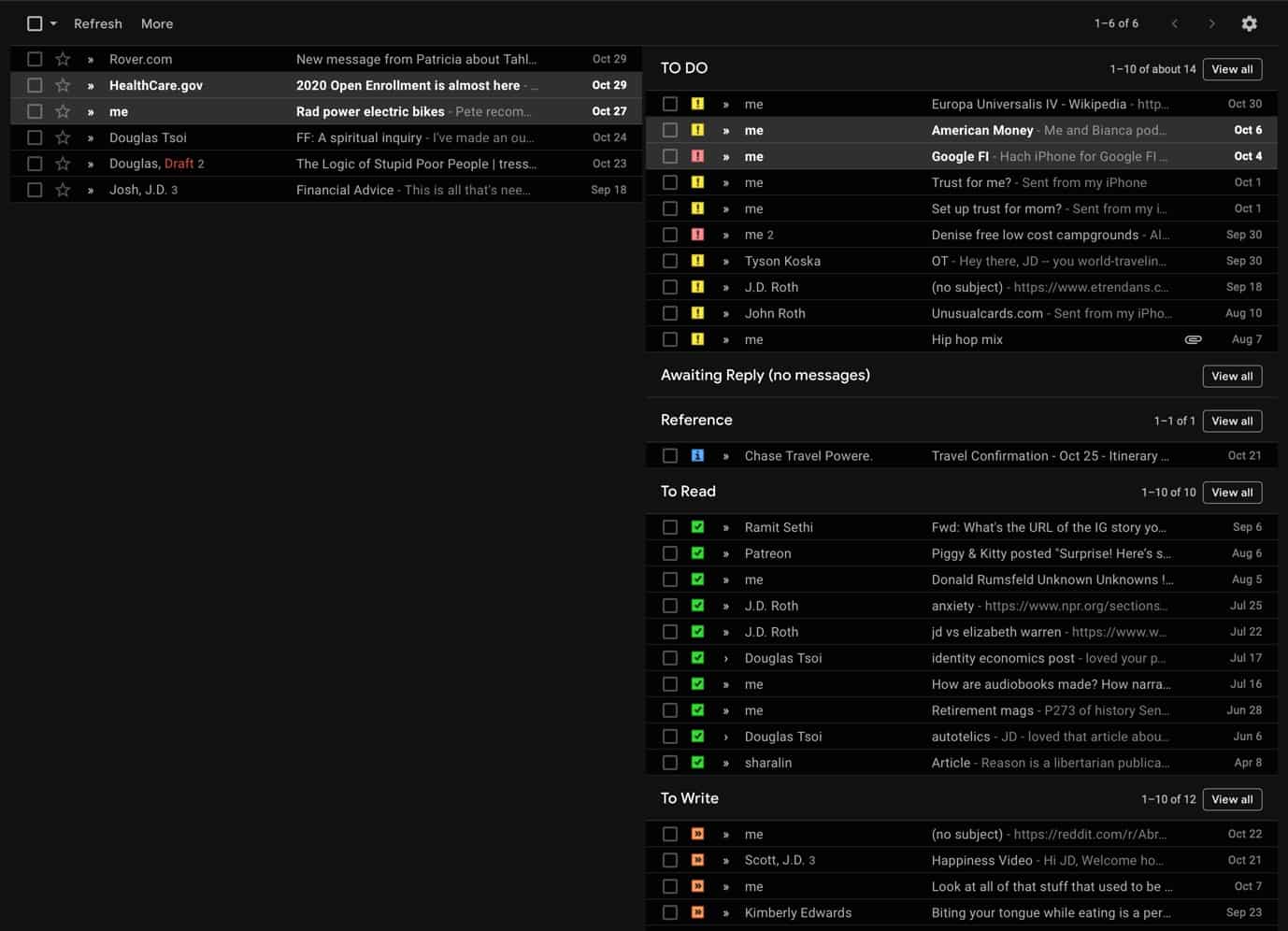
Charlotte spent twenty minutes walking me through an email system she recently adopted. It effectively divides your gmail inbox — and yes, you have to be using gmail — into five different inboxes, each of which is themed. Once a day, you tackle your main inbox, routing messages to sub-inboxes. Then, when you have time, you work through the other inboxes.
This is a minor change to the way I do things (and admittedly it mostly delays messages to later), but it's effective.
I send myself email twenty times each week. It's my note-taking system. It's how I offload things from my brain. This is great…except that my inboxes tend to get flooded with book recommendations, article ideas, and reminders of upcoming events. It's a mess. Using this system, I can still send myself messages, but I'm now able to flag these messages so they're routed to the appropriate sub-inbox.
I've been following Charlotte's advice for two weeks now, and I like it. It hasn't solved my email woe, but it's mitigated the problem substantially.
My inbox

Dozens of Credit Cards

Last weekend, Kim and I flew to Colorado to celebrate the birthday of a certain mustachioed friend. While there, I had several memorable conversations.
For instance, I chatted with Amy from Go With Less about how she and her husband play the credit-card game. They have an insane number of cards — 34? 43? I can't remember the exact count — and over three million credit-card points.
While our conversation touched on topics like manufactured spending (a concept that blows my mind and angers card issuers), I was more interested in how and why Tim and Amy juggle dozens of credit cards. Doesn't this hurt their credit score? Turns out: No. Because they pay bills on time and never cancel cards, they have nearly perfect credit.
Here's a video in which they address this topic:
I wanted to ask Tim and Amy more about their crazy credit-card fueled lifestyle, but I didn't have the chance. I look forward to picking their brains more in the future, though.

Health Shares for the Non-Religious

Last weekend, I also had a conversation with Ben, who famously gets his cars for free. Ben is super smart and doesn't accept the status quo. He's always looking for ways to challenge the system in order to make the most of his money.
Lately, he's been doing this with healthcare.
For many people who have retired early, health insurance is thorny issue. It's expensive. Take my case, for example. I pay $403 per month for shitty coverage. This year, I've met my $7900 out-of-pocket max, which means I'll have spent $12,736 (plus co-pays and prescriptions) when the dust settles. I hate the U.S. healthcare system. It's insane.
Well, Ben too thinks it's insane. Rather than complain about it, though, he's been seeking creating solutions.
“Have you looked at health-sharing ministries?” Ben asked me on Sunday morning. “They can be a great way to cut costs.”
“I have,” I said. “But they all require a statement of faith, which I'm not able to give.”
“I had the same problem,” Ben said, “so I searched for alternatives. I found Sedera. It's basically the same as a health-share ministry. You still have to agree to abide by certain principles, but they're not based on a religion.”
“Is it affordable?” I asked.
“Yes,” he said. “I'm paying $200 per month per person for my wife, my daughter, and myself.”
“That's not bad,” I said.
“But here's the thing,” Ben said. “Sedera is designed to work with a direct primary care physician.”
“A what?” I said.
“A direct primary care physician is just what it sounds like. It's a doctor that you work with directly without a third-party intermediary. That means the doctor bills you directly, not an insurance company. When you combine this with a health-sharing program like Sedera, it's a cost-effective alternative to traditional insurance.”
“Kim and I have an appointment to talk with an insurance broker next week,” I said. “I'll have to look into this as an alternative.”
“Do it,” Ben said. “You won't regret it.”

Downgrading My Motorcycle

Lastly, here's a topic that comes from several different conversations and a lot of soul-searching on my part.
When Kim and I started dating, I was surprised to learn that she was a motorcycle enthusiast. After she bought her father's bike from him, I decided to learn to ride myself.
I started with a low-power Honda Rebel, which was perfect for my needs. Then, a couple of years ago, I made an impulse purchase: I upgraded to a Harley-Davidson Street 750. The new bike gave me the power to keep up with Kim on long trips. (The little Rebel was always falling behind on the highway.)
Turns out, though, that for day-to-day riding, I wish I had my Rebel. Kim and I don't make many long trips — about one per year. And when we do, I'm fine falling behind. I'd rather have a quick and easy bike for running errands or zipping downtown. My Street 750 is not the right bike for this. It takes a long time to gear up and get the Harley ready to go.
I've spent the past year trying to figure out my best move. I've talked with a lot of friends and considered several options. Do I just stick it out with the motorcycle I have? Do I buy a new Rebel? Do I do something else?
After much thought and contemplation, I've decided that my best plan for the motorcycle situation is three-fold:
  • Sell the Street 750. Use the proceeds to purchase two replacements.
  • Buy a (used?) scooter to use for errands and running downtown. Kim plans to sell her motorcycle, so long trips are no longer an issue. I want something quick and easy to ride. I want to be able to get on the bike and go.
  • Buy an electric bike for use around home. I already own a bike, but as I've mentioned before, I don't ride it. For one, I am fat. For another, we are surrounded by hills. MMM has urged me to look into Rad Power electric bikes.
Making this move — which likely won't happen until the spring, when people are looking for motorcycles — is much more aligned with my values and lifestyle. Currently, my motorcycle mostly gathers dust. I ride it maybe 1000 miles per year. I'd ride the scooter more often, and the electric bike would get me out slicing through these hills for exercise!
What about you? What financial conversations have you been having with your friends? What minor money moves are you making in your life?

Credit card foreign currency transaction fees can take a big bite out of your vacation budget. They aren't fun to pay and they are av...

Image result for Foreign Transaction Fees: What They Are And How To Avoid Them
Credit card foreign currency transaction fees can take a big bite out of your vacation budget. They aren't fun to pay and they are avoidable. Save your travel funds by knowing the ins and outs of your credit card and switching to a card that will give you the best deal.
When you take your credit card on an international trip—or simply use it to buy something from an online merchant based overseas—you could pay a foreign transaction fee of 3 percent or more. If you take a vacation and spend $5,000 abroad with a card that has a 3 percent fee, you’ll pay $150 in foreign transaction fees.

What is a foreign transaction fee?

Although credit cards may provide a better currency exchange rate than a money-changing shop in a tourist neighborhood, your U.S. credit card may also change a foreign transaction fee, also known as a FX fee. Foreign transaction fees are different than the exchange rate.
These foreign transaction fees, often as much as 3 or 4 percent of the purchase in U.S. dollars, can add up quickly.
The thing to watch out for is that every card is different. Even two credit cards from the same bank may charge different foreign transaction fees.
Take two Chase credit cards, for example. The Chase Sapphire Preferred Card has no foreign currency transaction fees and is an excellent choice for international travel. The Chase Freedom card is a great card, but you might not want to take it on your next international vacation because it does charge a 3 percent fee on foreign transactions.
With that fee, as of September 2016, a €100 restaurant tab in Barcelona will cost you about $111.50 plus a foreign currency transaction fee of at least $3.45.

How to avoid paying a foreign transaction fee

To avoid paying forieng transaction fees, you have a couple of options: Use cash or bring a credit card that does not charge foreign transaction fees.
Although you can typically get a good exchange rate by using your debit card at foreign ATMs, it’s never safe to carry a lot of cash while you travel. And you definitely want to avoid using touristy money-changing shops whenever possible.
Fortunately, there are many good travel rewards cards don’t charge a foreign transaction fee, making them the best choices for international travel. Many come with other perks that will be appealing for your international trip—such as global concierge lines or rewards programs that can help you reach your next trip faster.

From highly technical guides to blogger’s individual stories of how they manage their own money, you can find just about any type of fi...

man on laptop
From highly technical guides to blogger’s individual stories of how they manage their own money, you can find just about any type of financial perspective.
We’ve gathered a list of the 50 best personal finance blogs of 2019 as the ultimate resource for finding the best information on the web.

1. Money Under 30

Don’t let the name fool you. Money Under 30 has great information no matter how old you are.
From loan advice to budgeting tips and a little bit of everything in between, this blog keeps up with regular content to keep you in the know. The most popular categories include credit cards, your credit, debt payoff, investing, home buying, and car buying.

2. Get Rich Slowly

Learn how to build your wealth over time at Get Rich Slowly. With a simple layout, this blog places a high premium on quality content to help educate readers on all things related to personal finance.
You’ll find tons of different topics here, including technical how to’s on investing as well as simple tips to earn money, like maximizing your next yard sale.

3. Frugalwoods

We love Frugalwoods because it’s all about a young couple documenting their path to financial freedom. After leaving the hustle and bustle of Boston, Mr. and Mrs. Frugalwoods now live on a multi-acre plot of land in rural Vermont.
They document how they build wealth through a frugal lifestyle. If you prefer pretty pictures and personal stories while learning how to manage your money, Frugalwoods is definitely worth checking out.

4. Oblivious Investor

Oblivious Investor is another personal finance blog that’s simply run by a guy who wants to put good content out into the world. Mike Piper takes you through the ins and outs of investing, providing insightful commentary for both beginners and those who don’t want to put a lot of thought into their portfolios.
For more in-depth reading, check out some of his books that give you the CliffsNotes version of financial topics.

5. Afford Anything

“You can’t afford everything, but you can afford anything,” is blogger Paula Pant’s personal mantra. This blog focuses a lot on real estate and income properties, with extremely transparent financials about her own endeavors.
However, there’s also a lot of worthwhile advice even if you’re not interested in buying real estate, from adjusting your mindset to increasing your productivity and earnings.

6. Debt Roundup

Blogger Grayson Bell started Debt Roundup after paying off $75,000 in credit card and auto loan debt. In addition to money-saving and money-making tips, Debt Roundup also provides free tools to help you manage your money, including paying off debt and investing money.

7. Squawkfox

Kerry Taylor is a consumer expert who shares her best money tricks and tips with readers on her blog Squawkfox.
It has the feel of a lifestyle blog intersected with personal finance and links to other media sources featuring Kerry, including television appearances and interviews. There’s a lot of personality interjected here, making Kerry’s posts full of flavor.

8. The Penny Hoarder

If you need ideas to earn more money, then The Penny Hoarder is the place to go. The site’s content is divided out by money hacks, work from home, budgeting, coupons, and freebies.
Everything is about either saving or making money and while some ideas are small (not surprising, considering the name of the site), there are tons of helpful resources on how to make money from the comfort of your own home.

9. Man vs. Debt

Created by Adam and Courtney Baker, who paid off their debt to travel the world, Man vs. Debt focuses on a single mantra: “Sell Your Crap…Pay Off Your Debt…Do What You Love!”
Needless to say, you’ll find countless tips and tricks for unloading the burden of “too much stuff” and empowering yourself to save more and do more.

10. Money Saving Mom

You don’t have to be a mom (or a dad) to appreciate Money Saving Mom. The website is updated with multiple posts each day, including coupon codes, grocery budget examples, and freebies.
You’ll also find a lot of inspirational content about how to prioritize your life’s passions and expand your income through multiple revenue streams. If you’re interested in blogging for money, MSM founder Crystal Paine offers a lot of in-depth pieces on how to start and grow your own blog.

11. My Money Blog

My Money Blog has been around since 2004, making it one of the oldest ongoing personal finance sites around. MMB creator Jonathan offers advice on how to manage your money to work towards early retirement.
There are tips on investing, saving money, and navigating credit card rewards programs. Jonathan also shares details of his experiences with all of his different investment and financial strategies so you can view actual numbers of success (and sometimes, failure).

12. Budgets are Sexy

As the title implies, Budgets are Sexy provides fun reads about all things personal finance, while following blogger J. Money’s personal experiences. He gives regular updates on his net worth changes, along with free tools and templates you can use for your finances.
You’ll also get tips on saving money, how to retire early, and inspirational guest posts from other bloggers. If you don’t mind the lack of filter, then this is a dynamic blog with a lot of actionable information.

13. Disease Called Debt

Hayley managed to pay off $62,000 in debt in less than two years and chronicles her story at Disease Called Debt.
She also showcases several debt success stories so you can get inspired and get ideas on how to successfully pay off debt. There are also helpful resources for managing money and blogging for profit.

14. Frugal Rules

Started by John Schmoll, a veteran of the financial services industry, Frugal Rules now features a variety of writers focusing on how to achieve “freedom through frugality.”
They’ll show you how to tackle common setbacks when paying off debt, tax tips, budget tools, investment guides, and more. The content runs the gamut of topics for beginners to more seasoned frugality pros looking for specific information.

15. Stefanie O’Connell

Formerly known as The Broke and Beautiful Life, Stefanie O’Connell rebranded her blog while still maintaining a commitment to showing you how to build your finances to live the life you want.
She primarily focuses on Millennials, but her advice is applicable to anyone who wants to save more and earn more. Having started off as an aspiring Broadway actress in New York City, Stefanie provides sage advice on how to get empowered through personal finance.

16. Pocket Your Dollars

Get nitty-gritty details on how to maximize coupons and other savings opportunities at Pocket Your Dollars. Everybody has to start saving somewhere, and the grocery store is a great place.
You’ll also find information on all kinds of ways to save, with the ability to browse by topic and print shopping lists from your favorite stores.

17. The College Investor

Written specifically for Millennials and college students, The College Investor offers personal finance advice tailored to a younger demographic. It’s especially helpful if you need help navigating the labyrinth of student loans, but also has tips for passive income and other income-earning side hustles.

18. Good Financial Cents

Here’s another blog that is perfect for a variety of readers. Good Financial Cents has a lot of content geared towards fledgling personal finance students while still putting out more in-depth articles for people who are already far down their money management path.
You can also submit a retirement-related question that will receive a guaranteed response within 72 hours.

19. 20 Something Finance

Though no longer in his 20s, G.E. Miller writes about holistic lifestyle changes you can make to embrace a debt-free way of life. He started off with significant debt and no savings and now saves 85% of his income.
20 Something Finance tackles all kinds of financial issues, like whether or not to financially support older parents or how much to spend on an engagement ring. You’ll also find tips on maximizing credit card rewards, ways to save on health insurance, and figuring out unemployment.

20. Financial Samurai

Financial Samurai delves into some deeper issues about wealth, from how to get it to who’s more likely to have it.
You’ll read about common characteristics of millionaires, successful investor mindsets, retirement planning, real estate, and more. There’s a little bit of everything here, but always from a unique angle you won’t get anywhere else.

21. Free Money Finance

This popular blog outlines ways to grow your net worth. At Free Money Finance, you’ll find personal narratives about creating multiple income streams, current investing strategies, as well as helpful insights on navigating your own career path.
The site’s simple layout places a focus on quality content, which is regularly posted by multiple contributors, so you always have a fresh perspective to read.

22. Cait Flanders

What started off as a blog documenting Cait Flanders’ quest to eradicate her debt has turned into a center for minimalistic living.
Her weekly updates include beautiful photography as well as tips on how you can incorporate a mindful budget while shopping less. In fact, Cait even implemented a two-year shopping ban after purging 75% of her belongings. Talk about inspiration!

23. Mr. Money Mustache

Mr. Money Mustache presents a quirky point of view grounded in smart commentary about financial topics. With more than 400 articles in the archives, you won’t run out of interesting reads to browse.
There are lots of reader success stories and case studies along with early retirement ideas, home improvement hacks, and more. Come for the mustache, stay for the content.

24. Money After Graduation

Run by Bridget Casey, Money After Graduation is geared towards helping young professionals achieve their financial goals.
With plenty of inspirational stories, MAG also gives in-depth tips on how to handle student loans, pay off consumer debt, and plan for retirement. Additionally, there are e-courses and workshops available if you want even more help getting on the path to wealth.

25. Everything Finance

It’s no surprise that Everything Finance touches on just about all things related to money and what we do with it.
From broad issues like personal loan analysis to more everyday topics like lowering your electric bill, it’s a great place to browse for ideas on how to create a financial game plan that works for you.

26. DailyWorth

DailyWorth is committed to creating positive relationships between women and money. Focus areas include managing your money, building a career, running a business, and living a fulfilling life.
Articles range from small-scale ideas on how to save money to large-scale analysis of the changing political scene. At the end of the day, though, each post is intended to be relevant and applicable to your everyday life.

27. Money Girl

Focusing on taxes, retirement, and insurance, Money Girl seeks to simplify finances for women and men alike.
You’ll find ways to manage bad credit as well as tips for being more disciplined with your finances. Founder Laura Adams also has some books available for even more helpful information on getting out of debt and growing your wealth.

28. Cash Money Life

Focusing on personal finance and careers, Cash Money Life skips the bells and whistles and simply delivers consistent quality content.
We like it because it offers detailed, actionable guides on managing your money. So not all of the content might apply to you, but when you find the posts that are relevant, they can add a lot of value to the way you handle financial decisions.

29. The Dough Roller

The Dough Roller was founded in 2007 by Rob Berger and has since expanded to a team of personal finance experts and contributors.
Their topics include banking, credit and debt, credit cards, insurance, and investing. In addition to helpful blog posts on everything related to money, you can also benefit from the website’s weekly newsletter and regular podcasts.

30. Retire by 40

Joe retired from his corporate gig at Intel to become a stay-at-home dad. He and his wife save most of her income and pay for all of their expenses with other sources of income they’ve developed.
His blog, Retire by 40, tracks their financials regularly while tackling money-related family issues, large and small.

31. Girls Just Wanna Have Funds

If you love personal finance and puns, then this blog is the one for you.
At Girls Just Wanna Have Funds, you’ll find career and negotiation tips, advice on improving your credit, and ideas on how to start and grow your own business. Topics range from anything you can imagine, and despite the blog’s title, they’re actually relevant for women and men alike.

32. Early Retirement Extreme

Early retirement blogs are quite common as people become less enamored with the corporate 9-5 grind. At Early Retirement Extreme, the secret formula is “a combination of simple living, anticonsumerism, DIY ethics, self-reliance, and applied capitalism.”
Sounds easy enough, right? Not really, which is why the blog regularly features posts on real-life strategies to achieve your financial independence. There are also a number of guest posts so you can read multiple perspectives.

33. The Centsible Life

Kelly Whalen targets women for her blog The Centsible Life, but again, good advice transcends gender. From how to financially complete your bucket list to cheap things to do with your kids, this website has tons of great advice for anyone looking to use their money more intelligently.

34. Wealth Pilgrim

For technical information on banking, investing, and retiring, the Wealth Pilgrim is definitely a great resource.
There are plenty of in-depth “ultimate guide” for just about any money-related issue you could imagine. The entire website is also well-organized so you can easily browse topics you’re interested in or search for something more specific.

35. Our Next Life

Our Next Life follows the story of Tanja Hester and her husband, Mark Bunge, on their early retirement journey. The couple retired at the end of 2017 at ages 38 and 41.
You can follow their inspiring journey from demanding careers to a work-optional lifestyle. If retiring early sounds interesting to you, then definitely check out this one.

36. Couple Money

Whether you and your better half are on the same page when it comes to finances or need help finding common ground, Couple Money is the place to start.
You’ll find personal exercises you can work on together (like a $20 date night challenge) as well as working together to create and achieve financial goals.

37. Northern Cheapskate

Northern Cheapskate provides helpful resources on debt and credit relief, along with money-saving ideas to help you pay down your debt. In addition to financial advice, the blog presents a ton of DIY tips, where to find all kinds of freebies, and even handmade gift ideas.

38. MirandaMarquit.com

Instead of focusing on small ways to save, Miranda Marquit shows you how to grow wealth. Through financial, investment, and home business advice, you’ll learn the ins and outs of building your money and making it work for you. Head over to start growing your money tree now.

39. Ask Liz Weston

Have a question about personal finance? No problem, just Ask Liz Weston, an online columnist devoted to taking the mystery out of money. There are almost daily updates on newsworthy topics, but most interesting are the individual questions submitted by readers.
It’s a great way to get insight into financial matters you might not ordinarily think of — like what happens to debt after someone dies, or how to close a credit card account without hurting your credit score.

40. Frugal Beautiful

Frugal Beautiful follows the life and advice of debt-free crusader Shannyn, who champions frugal budgets while living the life you want.
It’s a personal finance-meets-lifestyle-and-beauty blog. Shannyn’s categories include finances, house & home, lifestyle, and growth. If you need an uplifting point of view on money and life in general, this one should be part of your weekly reads.

41. Punch Debt in the Face

Who can resist a blog with such a straightforward name? After paying off nearly $30,000 in debt, “Ninja” now writes about financial advice as well as his personal experiences with money at Punch Debt in the Face.
He’s upfront about his income and expenses so you can get an idea of how it’s possible to cut back in some areas in order to pay off debt or save more aggressively. He’s also committed to relating his story to keep the “personal” in personal finance.

42. Prairie Eco-Thrifter

You’ll find a lot of financial advice on Prairie Eco-Thrifter, but more than that, you’ll find practical information on how to live green and clean on a budget.
It’s the perfect pairing of personal finance and sustainable living how-tos. There’s also an interactive community of commenters, and you can submit a question to ask other readers for their advice on issues you may be having.

43. Don’t Mess With Taxes

Taxes are an integral part of personal finance, especially if you have income that isn’t taxed regularly from your employer.
Don’t Mess With Taxes chronicles all types of interesting scenarios that can affect your taxes, and how you can handle them. From how to spot tax scams to how to claim winnings from a sports bet, this blog is chock-full of helpful information.

44. Money Smart Life

Ben puts a fresh spin on his lifelong passion for personal finance at his blog Money Smart Life. Topics he covers consist of taxes, career, frugality, investing, debt, and real estate.
His blog posts are extremely in-depth so that you gain a true understanding of the topic at hand, whether it’s finding the best savings account for youth sports or how to shake bad financial habits.

45. The Military Wallet

If you’re a member of the military, a veteran, or family member of one, then The Military Wallet is a must-read for you.
It outlines both personal finance and benefits issues for military and veteran families to make sure you’re taking advantage of all the perks available to you because of your service. You can learn all you need to know about VA disability, discounts, and military money tips.

47. PT Money

Phillip Taylor (the PT of PT Money) is a CPA and entrepreneur who combines blog posts with podcasts to give you sound financial advice in all areas of life.
He gives you savings strategies, tax tips, and even money-wise gifts for your kids. PT Money is also up to date on the latest money management apps so it’s a great place to stay on top of the latest technology that can help your wallet.

47. Moolanomy

A personal finance website without the bells and whistles, Moolanomy focuses on four pillars of personal finance: income management, expense management, asset management, and debt management.
So you can learn anything from building an extra income or passive income to reducing debt or selecting the right insurance plans. It covers just about any financial topic that could come up throughout life.

48. Free From Broke

With the tagline of “Personal Finance Made Easy,” Free From Broke lives up to these expectations by hashing out tips and tricks to help reduce your debt and build wealth.
Founder Glen Craig offers investment reviews, goal-setting strategies, and behavioral analysis to set yourself up for success.

49. Len Penzo

A self-described “offbeat” blogger, Len Penzo champions making responsible financial decisions and forming positive habits.
On top of regular personal finance advice, you’ll also see great posts like dating on a budget, avoiding financial suicide, and saving on medical expenses.

50. The Financial Diet

The Financial Diet was founded in 2014 by Chelsea Fagan to track her own money journey. Now, the website published hundreds of different voices from women about their personal finance stories.
Many of the stories are refreshingly honest about the struggles of navigating personal finance as a female in today’s world. You can find articles on a range of topics including budgeting, increasing your income, affordable home decor, and personal essays about balancing finances with a purposeful life.